Bytrionly
Delta Pack
Delta Pack
Couldn't load pickup availability
Share
1. Problem Statement
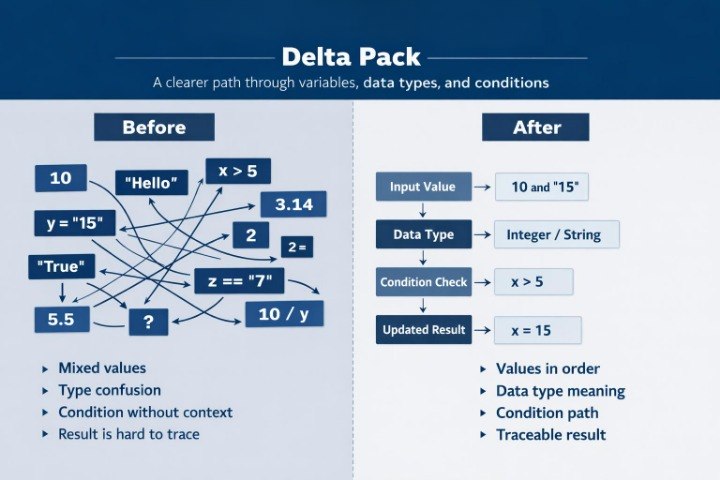
After the first introduction to C++ programming, a new difficulty often appears: separate concepts may feel familiar, but their connection is not always clear. A learner may understand what a variable or a condition is, yet still feel unsure when these elements appear together in one example. Because of this, code may look like a group of separate lines rather than a logical pattern. Another challenge is that basic topics are sometimes covered too lightly, without enough small exercises. Delta Pack helps learners study the first C++ constructions more carefully and see how they work inside simple tasks.
2. Solution
Delta Pack presents basic C++ programming topics through organized explanations, short examples, and tasks for independent review. In this tier, attention is given not only to writing code, but also to reading its logic: what happens first, which values change, where a check appears, and what result it may produce. The materials help learners move gradually from separate concepts to small connected examples. Each module explains the role of a specific element, so the learner can see not just syntax, but the order of actions. This format supports calm study without pressure or loud marketing claims.
3. What’s Inside
Delta Pack includes an expanded introductory set of materials that continues the logic of Free Pack and adds more examples for careful review. The main idea of this tier is to show how basic parts of C++ programming work together inside small tasks, rather than appearing as isolated items. The materials are arranged so the learner can move from reading code to explaining its logic independently.
The first section focuses on variables and values. It explains how a variable is created, how a value is assigned to it, how that value can be changed, and how it is used in later lines. There is also attention to why a variable name should be clear for reading code. The examples show situations where one variable stores a number, another takes part in a calculation, and a third keeps an intermediate result.
The second section focuses on data types. The learner studies why different kinds of data have different roles in a program. The materials explain how numbers, characters, logical values, and simple text fragments work. The explanation avoids unnecessary overload, while still showing how the wrong type can change code behavior. The examples help show the difference between a value used for calculation and a value used for checking or output.
The third section is about conditions. It explains how a program can check values and perform different actions depending on the result of that check. The learner sees how a simple condition works, how an alternative branch is added, and how several checks can form more branching logic. The materials explain how to read these blocks from top to bottom without getting lost in braces or nested parts.
The fourth section covers simple calculations. It shows how variables can take part in mathematical actions, how to store the result, and how to use it in later parts of a program. The examples are built around small tasks: counting values, comparing numbers, and changing a result depending on a condition. This section helps learners see that calculation in code is not only a formula, but also a part of the overall program logic.
The fifth section includes practice exercises. They are created for independent topic review without grading or pressure. The learner receives short code fragments, line-completion tasks, questions for explaining the result, and mini-scenarios where the right construction needs to be chosen. These exercises help reinforce the material through repetition and attentive reading.
Delta Pack also includes review notes after each section. They briefly summarize the main ideas of the topic: what a variable does, when a condition is needed, how data types differ, and how calculations connect with the program result. These notes can be used as a helpful reference during review.
4. Who Is This For?
Delta Pack is suitable for learners who have already taken their first steps in C++ programming and want to move into a more detailed review of basic topics. It fits people who know separate terms but want to understand how they work together in code.
This tier is also suitable for those who want more practice with small examples. When a learner wants not only to read explanations but also to see several ways to use variables, conditions, and simple calculations, Delta Pack provides an organized foundation. The materials may also be useful for review after a pause or for preparation before later topics such as loops, functions, and more complex structures.
5. What You’ll Learn
- How variables store and change values in a program.
- How basic data types differ in C++ programming.
- How to read simple conditions and understand their result.
- How to combine variables, calculations, and checks in one example.
- How to see the order of actions in a short code fragment.
- How to explain the role of each line in a small program.
- How to avoid confusion between a value, a type, and a calculation result.
- How to work with short practice exercises.
- How to prepare for later topics where code has more connections between parts.
- How to gradually develop attention to C++ syntax and logic.
6. 30-Day Refund Note
Delta Pack includes a 30-day period during which a refund request may be submitted according to the Bytrionly store terms. The request is reviewed under the rules described in the store policy. Before placing an order, we recommend reviewing the tier description, the list of materials, and the topics included in this set. If clarification is needed regarding the format or course content, the Bytrionly team can respond through the contact page.
- 📘 Digital file available after purchase
- 📚 Long-term availability
- 🔐 Secure checkout
- 🗓️ Content updated in 2026
Self-paced learning overview
1. Are these courses suitable for beginners in C++ programming?
1. Are these courses suitable for beginners in C++ programming?
Yes, Bytrionly materials are organized so a learner can gradually work through the topic without being overloaded by terminology. The lessons explain basic concepts, code examples, syntax logic, and the order of actions. Each tier has a different scope of materials, so learners can choose a format that matches their own study pace.
2. What is included in the learning materials?
2. What is included in the learning materials?
Depending on the tier, the materials may include topic explanations, code examples, structured modules, independent practice tasks, short notes, review sections, and practical examples. All materials are built around C++ programming and arranged as a step-by-step learning path.
3. Can I study at my own pace?
3. Can I study at my own pace?
Yes, Bytrionly materials are suitable for independent study at a comfortable rhythm. You can return to topics, repeat examples, review explanations, and work with code as many times as needed for better understanding.
4. How are the tiers different from each other?
4. How are the tiers different from each other?
The tiers are arranged in ascending order by content volume, topic depth, and number of learning sections. The first tiers introduce the basics of C++ programming, while the later ones add more topics, tasks, examples, and structured materials for deeper study.