Bytrionly
Arc Guide
Arc Guide
Couldn't load pickup availability
Share
1. Problem Statement
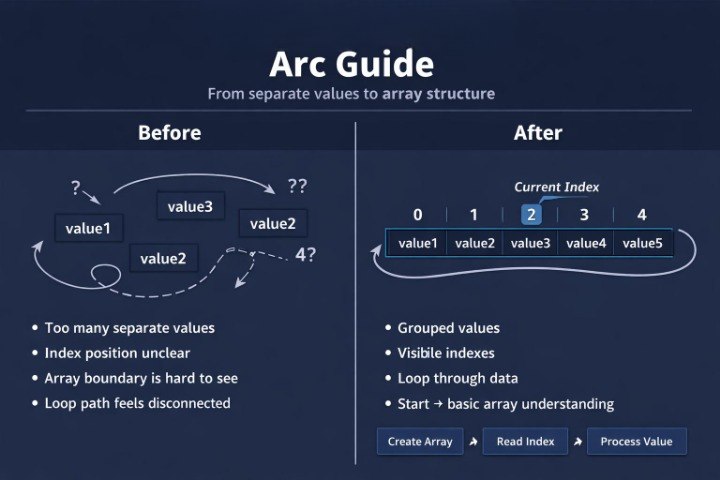
When a learner moves from separate variables to groups of values, code begins to require a new way of thinking. Instead of one number or one text fragment, there is now a set of elements that needs to be stored, read, changed, and processed in a certain order. At this stage, confusion often appears around indexes, array boundaries, and why the first element has a number that may not feel obvious at first. Another challenge is that arrays are often connected with loops, so the learner needs to watch both the counter and the element value at the same time. Arc Guide helps learners study this topic through ordered examples, attentive code reading, and exercises with small data groups.
2. Solution
Arc Guide explains arrays as a way to work with a group of values without creating many separate variables in a scattered way. The materials show how an array is declared, how elements are placed inside it, how to refer to a specific value, and how to change it while the code runs. Separate attention is given to indexes because they often become the source of mistakes in early examples. The learner sees how a loop can move through an array, read each element, and perform a certain action on it. This approach helps show an array not as a difficult written form, but as an ordered group of data with its own logic.
3. What’s Inside
Arc Guide includes learning materials that continue the path after Motion Module and introduce arrays in C++ programming. The main goal of this tier is to explain how to work not with one value, but with a group of values that share one structure. The materials are presented so the learner can gradually move from separate variables to indexed elements and see how arrays interact with loops, conditions, and functions.
The first section introduces the idea of an array. It explains why it can be inconvenient to create many variables for similar values and how an array allows such values to be gathered into one structure. The learner sees examples with numbers, scores, counters, result groups, and simple sequences. In this section, the important point is to understand that an array is not just a longer form of a variable; it has its own system for placing elements.
The second section focuses on declaring an array. The materials explain how the element type, array name, and number of values are written. There is a separate review of why all elements in one array share the same type and how that affects later work with code. The examples show arrays of numbers, characters, and simple values for checks. The learner studies how to read an array declaration line not as a difficult construction, but as a short description of a data group.
The third section focuses on indexes. It explains how to find a specific element in an array, why indexing begins from zero, and how not to confuse an element number with its value. The materials show examples where the learner needs to read the first element, change one of the middle elements, or compare two values from different positions. Common situations are also reviewed where an index moves beyond the array boundary and why that can disturb the logic of an example.
The fourth section explains work with arrays through loops. The learner sees how a loop counter can also be used as an index for referring to an element. The examples show outputting all values, counting a sum, finding a certain number, and changing each element according to a rule. In this section, it is important to watch two things at the same time: the current pass number and the value stored in the array at that position.
The fifth section is dedicated to simple analysis of values in an array. The materials explain how to count elements that match a condition, how to find the highest or lowest value, how to compare neighboring elements, and how to store an intermediate result. All examples remain compact, but they already show that arrays allow data to be handled in a more ordered way. The learner sees how conditions and loops become part of working with a group of values.
The sixth section combines arrays with functions. It explains how a separate action on an array can be moved into a function: counting, checking, outputting, or changing elements. The materials show how a function can receive an array for work and perform a separate task with it. This approach helps show the connection between the previous tier about functions and the new topic about data groups.
The seventh section contains practice tasks. They are built around short scenarios: create an array of several numbers, change a value by index, move through all elements with a loop, find a value by condition, and explain the result of a code fragment. Some exercises ask the learner not only to write a line, but also to explain why a certain index is used in a specific place.
Arc Guide also includes summary notes after each topic. They help recall what an index is, how an array boundary works, why a loop is often used together with an array, and how to read code where a group of values, a check, and repetition appear together. These notes can be used during review or before moving to later tiers where strings, structures, and wider examples with data appear.
4. Who Is This For?
Arc Guide is suitable for learners who already know basic C++ programming constructions and want to study how to work with several values inside one structure. This tier fits those who understand variables, loops, and functions, but still feel unsure when indexes and groups of elements appear in code.
The materials also suit those who want to read code with data groups more attentively. When it is difficult to understand which element is being processed inside a loop, Arc Guide helps divide this process into separate steps. The tier may be useful for independent study, array topic review, or preparation for later sections where data is stored in more detailed forms.
5. What You’ll Learn
- How the idea of an array works in C++ programming.
- How to declare an array and read its structure.
- How to refer to elements by index.
- Why indexing begins from zero.
- How to change separate array elements.
- How to move through an array with a loop.
- How to count values inside an array.
- How to find elements by condition.
- How to combine arrays with functions.
- How to explain the result of a code fragment that includes an array, a loop, and a condition.
6. 30-Day Refund Note
Arc Guide includes a 30-day period during which a refund request may be submitted according to the Bytrionly store terms. The request is reviewed under the rules described in the store policy. Before placing an order, we recommend reviewing the tier description, the list of materials, and the topics included in this guide. If clarification is needed about the content or learning format, the Bytrionly team can respond through the contact page.
- 📘 Digital file available after purchase
- 📚 Long-term availability
- 🔐 Secure checkout
- 🗓️ Content updated in 2026
Self-paced learning overview
1. Are these courses suitable for beginners in C++ programming?
1. Are these courses suitable for beginners in C++ programming?
Yes, Bytrionly materials are organized so a learner can gradually work through the topic without being overloaded by terminology. The lessons explain basic concepts, code examples, syntax logic, and the order of actions. Each tier has a different scope of materials, so learners can choose a format that matches their own study pace.
2. What is included in the learning materials?
2. What is included in the learning materials?
Depending on the tier, the materials may include topic explanations, code examples, structured modules, independent practice tasks, short notes, review sections, and practical examples. All materials are built around C++ programming and arranged as a step-by-step learning path.
3. Can I study at my own pace?
3. Can I study at my own pace?
Yes, Bytrionly materials are suitable for independent study at a comfortable rhythm. You can return to topics, repeat examples, review explanations, and work with code as many times as needed for better understanding.
4. How are the tiers different from each other?
4. How are the tiers different from each other?
The tiers are arranged in ascending order by content volume, topic depth, and number of learning sections. The first tiers introduce the basics of C++ programming, while the later ones add more topics, tasks, examples, and structured materials for deeper study.